
DEVLOG#12: Celestial wonders
Black holes
A recently introduced feature is warpholes / blackholes. In the Quark galaxy, we’re deliberately conflating the two... After some astrophysics research, it did not seem like having blackholes in the game would serve any purpose other than to murder travelers ; so I opted for the implementation of every black hole is a twin, which allows for crossing (W/ penalty to the ship hull). And scars or tears in spacetime can open up into these periodic warpable waypoints.
Some interesting physics fall out of these:
Blackholes only emerge in void sectors , where significant vacuum exists. If two void sectors of relevant distance from each other exist, a blackhole has the probability of forming in the void.
Every hole's look derives from its own canonical mass, temperature and luminosity: heavier beams harder and wraps more arms (faster inner orbits), brighter is more turbulent and reaches further (fed harder), hotter sits bluer with thinner filaments.
Ironically, larger, heavier, more massive black holes do less damage to ships (This is a speculated physics phenomenom! A heavier hole has a gentler horizon). And longer, skinnier ships, actually suffer the least when crossing.
Stellar lighting
Another interesting programming dilemma was the creation of true stellar lighting. We wanted to make looking at stars in the Quark world a magnificent experience. I feel that a lot of how games do stars is cliched and doesn’t use enough real-world considerations mixed with artistry.
In Quark, our luminosity table spans 11 orders of magnitude. The visual detail of each star is determined by its luminosity, heat, size, etc. Cool stars carry convective envelopes and granulate visibly; hot massive stars are radiative near the surface and look glassy. Flares are actually simulated and have impact on passing ships that are not EMP-shielded! So many cool lighting effects, such as haze (blur), bloom, corona, and coronal rain are all simulated visually. For a reference, check out the Supergiant experiencing a solar flare below:
walkable surfaces
A major change in the game’s structure involves the translation of the various planet, dwarf planet, moon, and (~20%) of asteroid surfaces into actually geodesic hex-based projections. That means, that each hex cell acts as a localized area with its own inhabitants, stats, weather, critter migrations. Previously, you would see an entire planets’ sites all from the same spot of the planet and there was no “traversal”, nor travel across the surface. You just pointed and clicked at infrastructure to move.
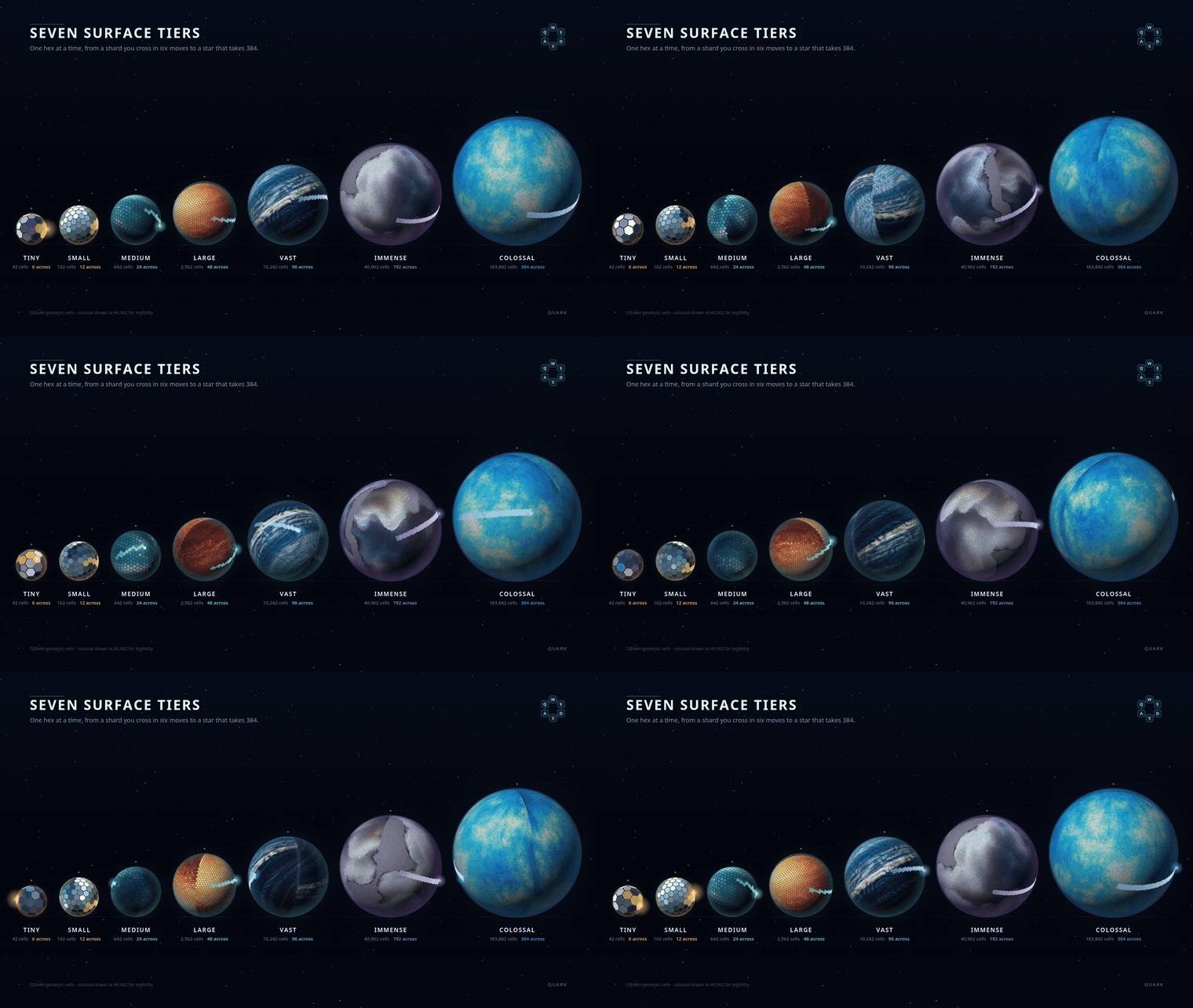
Now, the world’s span from Tiny (42 hex cells) to Colossal (~163k cells), perfectly wrapped spheres on the spheroid worlds. For irregular solids - things that would not be represented by a sphere - an adapter is made that will still allow for traversal, but it’s WIP!
Although this sounds like an obscene amount of explorable space. It is actually not, given that we need to provide living space to potentially thousands of players. Even the largest body on this scale can be crossed in 384 lateral moves
AS ALWAYS,
The wonders continue! STAY TUNED as we figure out more and more of the space flight and infrastructure. And check out our new social media post covering this same topic!
Bluesky: https://bsky.app/profile/playquark.bsky.social/post/3mtyox4yihc2g
TikTok: https://www.tiktok.com/t/ZP87WmAQP/
X: https://x.com/playquark/status/2092643265262878869?s=46